

The Smart Cities & Integration of Citizen Processes
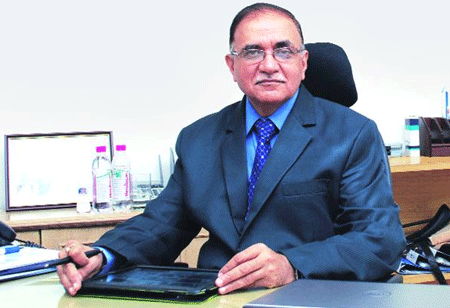
Ashok Sethi, COO & Executive Director, Tata Power
Since the launch of the Smart Cities mission in 2015 to develop 100 cities, a lot of progress has been made. The Ministry of Housing and Urban Affairs has informed the LokSabha in end November 2018 that 2342 projects worth Rs.90,929 crore have been tendered-out of which 1675 projects worth Rs.51,866 crore are under implementation or have been completed. Thus, with a total planned investment of Rs.200,000 crore, over 45 percent of the projects are in implementation stage.
At the same time, India’s urban population is fore casted to reach 50 percent by 2030 and ensuring essential services such as housing, transportation, sanitation and many others could be a challenge. Our honorable Prime Minister, Mr. Narendra Modi has said, “If anything has the potential to mitigate poverty it is our cities”. Our cities are engines of growth and pivot of economic activity and employment. They are not only economic and administrative hubs, but also the socio-cultural hubs of their respective regions. Today, numerous Indian cities are facing challenges such as emigration, environmental pollution, crumbling infrastructure, poor employment opportunities and inefficient/inadequate civic services.
A self-sustaining city with circular economy shall be dream of being a smart city. A smart city needs among many other things, good governance, convenient
commuting, convenient civic services, relevant employment opportunities, affordable housing, medical facilities, education, futuristic civic infrastructure, sustainable waste and energy management, green spaces and a hygienic and safe environment. Thus, a well-designed city focuses on making a citizen’s life convenient, healthy, happy and productive. A smart city is not about using technology interventions just for the sake of implementing them, but using technology to enable the above-mentioned characteristics with the ultimate outcome of making a citizen’s life better.
"Through effective implementation of transport facilities, ensuring green cover, civic services, education and sustainable livelihoods. The final step would be to become a smart city by implementing integrated citizen processes"
As per Lorraine, Hudson and Korteum,‘Introduction to smart cities’,a smart city should have the following elements –
•Bottom-up approach to define a citizen’s needs
•Define metrics and indicators to measure a city’s performance
•Have future-ready infrastructure using technology, sensors, and data management
•Effective leadership and inclusive decision making
Each municipal body should first assess itself to understand the current status of the city with respect to the characteristics mentioned above. It should then define where it wants to be through a comprehensive discussion with all stakeholders. Finally, the local body should create the roadmap to achieve the end state using the appropriate process and technology interventions.
A possible road map could be first ensuring the basic and most essential services such as clean water, clean air, sewage management, waste management, and good governance. Once these are in place, the roadmap shall take the city to the next level, i.e.,a convenient life. Through effective implementation of transport facilities, ensuring green cover, civic services, education and sustainable livelihoods. The final step would be to become a smart city by implementing integrated citizen processes through technology-enabled solutions and bringing in circular economy. This would ensure making the city sustainable across environmental, economic, social and cultural aspects.
"Through effective implementation of transport facilities, ensuring green cover, civic services, education and sustainable livelihoods. The final step would be to become a smart city by implementing integrated citizen processes"
As per Lorraine, Hudson and Korteum,‘Introduction to smart cities’,a smart city should have the following elements –
•Bottom-up approach to define a citizen’s needs
•Define metrics and indicators to measure a city’s performance
•Have future-ready infrastructure using technology, sensors, and data management
•Effective leadership and inclusive decision making
Each municipal body should first assess itself to understand the current status of the city with respect to the characteristics mentioned above. It should then define where it wants to be through a comprehensive discussion with all stakeholders. Finally, the local body should create the roadmap to achieve the end state using the appropriate process and technology interventions.
A possible road map could be first ensuring the basic and most essential services such as clean water, clean air, sewage management, waste management, and good governance. Once these are in place, the roadmap shall take the city to the next level, i.e.,a convenient life. Through effective implementation of transport facilities, ensuring green cover, civic services, education and sustainable livelihoods. The final step would be to become a smart city by implementing integrated citizen processes through technology-enabled solutions and bringing in circular economy. This would ensure making the city sustainable across environmental, economic, social and cultural aspects.